About
PhD student in Computer Science at UC Santa Cruz, studying how people experience security, privacy, and AI through internet measurements, experiments, and interviews.
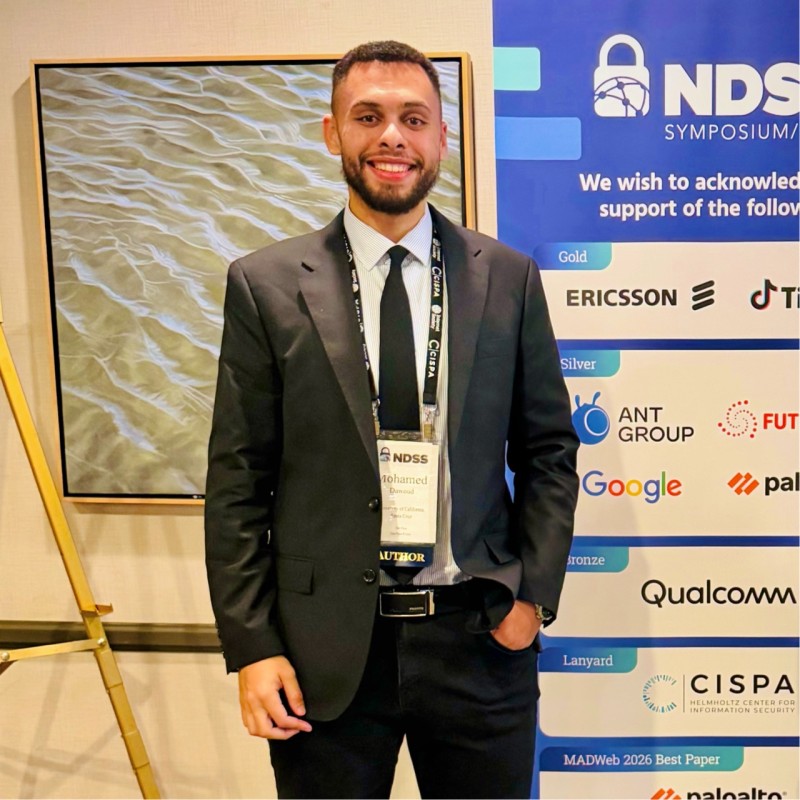
I am a PhD student in Computer Science & Engineering at the University of California, Santa Cruz, where I am fortunate to be advised by Prof. Ramakrishnan (Ram) Sundara Raman. I am an empiricist. Internet threats are changing quickly as AI spreads, and protecting users now means treating security and privacy as socio-technical problems rather than purely technical ones.
Engineering 2 (E2), Room E2-311
1156 High Street, Santa Cruz, CA 95064
Research
Technology has to be designed from evidence of how real people use, misuse, and experience it. Technical defenses on their own do not hold up. We also need to understand how AI is deployed and misused across the systems and institutions that shape everyday digital life. My research is in human-centered security and privacy. I study how technology, policy, and people's lived experience intersect, and where that intersection undermines trust. I am especially interested in how different stakeholders form their mental models of security and privacy: how everyday users understand digital protections, how engineers weigh trade-offs under pressure, and how policymakers interpret ambiguous or conflicting regulations. Through large-scale internet measurements, experiments, surveys, and interviews, I look for where misunderstandings and compliance failures emerge, and I design interventions to close those gaps.
In collaboration with Stanford, I study how AI privacy and governance frameworks work in practice: how engineers interpret ambiguous regulations, how organizations deploy generative models under pressure, and where governance intentions diverge from what gets implemented. With Princeton CITP, I measure how deepfake production, synthetic identities, and other AI-enabled abuse offerings spread on freelance marketplaces, some of the first empirical evidence of how AI-enabled harm is packaged and sold at Internet scale. A third line of work audits websites under the CCPA from two sides at once, LLM-based evaluation of privacy policies and automated measurement of cookie tracking, to see how the law changes transparency and tracking behavior.
I am also interested in how AI can be used defensively. Beyond studying threats like deepfakes and disinformation, I look at how large language models can help the people in this ecosystem: users trying to make sense of risks, experts making decisions, and policymakers who need clearer evidence. My long-term goal is evidence-based redesign of technology and policy that narrows the gap between users, practitioners, and policymakers, so that both serve the people they affect.
The published work is on the publications page.
Where I Come From
I proudly come from Zefta, Egypt, a city that once declared itself the Zefta Republic during the 1919 revolution. I grew up on that story of defiance, and it still shapes how I approach things. As a high school student I ranked 18th out of more than 600,000 students nationwide in Egypt’s Thanawya Amma mathematics exam, which earned me a full merit scholarship to study Computer Science (Information Security) at the German International University in Cairo.
While still in Egypt, I worked remotely with Prof. C. Jordan Howell on cybercrime and underground economies, which led to a publication in Computers in Human Behavior. I then came to the United States as a research intern at Georgia Tech, where I worked under Prof. Brendan D. Saltaformaggio on systems security and contributed to research published at USENIX Security. I continued to MBZUAI in Abu Dhabi, researching deepfakes and responsible AI, then to Dartmouth College as a Graduate Teaching Assistant, where I helped redesign a Security & Privacy course so that students could use AI tools but had to defend their work in oral evaluations. I also represented Dartmouth at the AAAS CASE Workshop in Washington, D.C., where I met with policymakers on science and technology policy.
Community
I co-founded Egyptians in CS Research, a directory of 262 Egyptian computer science researchers across 16 tracks worldwide. I also run an annual mentorship program for prospective PhD applicants, particularly from regions with little access to research mentorship, covering research statements, program selection, and application strategy.
More on this on the service & outreach page.
Beyond Research
When I’m not buried in research, you’ll probably catch me at the gym, walking along the California coast, wandering through redwood forests, or chasing down the next great coffee shop.
I tell myself these moments are breaks from research, but truthfully, even while sipping coffee or hiking a trail, my mind drifts back to the same question: how can I leave the world better than I found it?
Sometimes that means pushing my research forward, sometimes it means dreaming about building impactful startups, and sometimes it simply means working hard to be kind and present with the people around me.
Best way to reach me is mdawoud@ucsc.edu.